Why Repeatability and Accuracy Matter in Soil Testing
Article Summary
- Accurate and repeatable soil test results are foundational to sound agronomic decisions, because fertility recommendations, nutrient budgets and long-term soil health strategies all depend on the quality and consistency of the underlying data.
- Inconsistent lab results can cause large swings in fertilizer rates and cost per acre, even when testing the same soil, leading to unnecessary over‑ or under‑application.
- Repeatable soil testing gives you confidence over time, allowing you to fine-tune your fertilizer programs and make profitable, data-driven decisions amid tight margins and volatile fertilizer prices.
Soil testing is one of the most important data points used in agronomic decision-making. Fertility recommendations, nutrient budgets and long-term soil health strategies all begin with soil test results. Because farmers and agronomists rely on these numbers to guide input decisions, the quality of the data matters as much as the recommendation itself.
Repeatability and accuracy are two characteristics that determine whether soil test results consistently support good decisions over time.
Understanding Accuracy and Repeatability
Accuracy refers to how closely a soil test result reflects the true nutrient level present in the soil. Repeatability describes how consistent the results are when the same soil is tested multiple times under the same conditions. Both are necessary.
A test can be accurate once but inconsistent over time, which creates uncertainty. A test can also be repeatable but inaccurate, producing consistent results that do not represent actual soil conditions. Soil test results must be both accurate and repeatable so we can make sound agronomic decisions.
Evaluating Repeatability by Comparing Labs
Repeatability can be evaluated through controlled laboratory comparisons. We conducted this study with a 5-gallon sample collected from a known soil type. That soil was sieved and thoroughly homogenized so that every subsample drawn from it contained the same nutrient concentration.
Multiple subsamples were taken from this single source and submitted to multiple laboratories. Each lab received three samples per repetition, and five total repetitions over the course of four months. Because the soil itself did not change, any variation in reported results shows us how consistent a lab's analysis procedures are on a given sample day, and how they hold up over time.
To summarize our results, we compared the average value reported over six weeks with the minimum and maximum values reported during that same period. Narrow ranges indicate strong repeatability, while wider ranges indicate greater variability.
Phosphorus Results and Fertility Categories
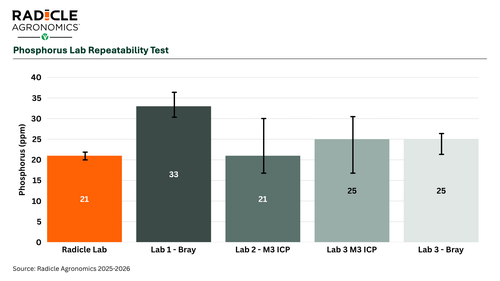
Phosphorus testing provides a clear example of why repeatability matters. In this comparison, our Radicle Lab reported an average phosphorus value of 21 ppm over four months using a Mehlich-3 colorimetric phosphorus analysis. The minimum and maximum reported values were 20 ppm and 22 ppm.
According to Iowa State University phosphorus recommendations for corn, a Mehlich-3 colorimetric phosphorus value of 21 ppm falls within the optimum soil test category. At this level, the recommended application rate is 67 pounds of P2O5 per acre. Because all reported values from our lab remained between 20 and 22 ppm, every result stayed within the optimum range and led to the same fertilizer recommendation.
Another laboratory (Lab 2 in the table) also reported an average phosphorus value of 21 ppm over four months, but its results showed much greater variability. Minimum and maximum reported values were 17 ppm and 30 ppm using a Mehlich-3 ICP phosphorus analysis.
In this case, a reported value of 17 ppm places the soil test in the low phosphorus category, which recommends applying 85 pounds of P2O5 per acre. A reported value of 30 ppm places the soil in the optimum category, with a recommendation of 67 pounds of P2O5 per acre. The result is an 18 pound difference in recommended phosphorus application for the same soil. With phosphorus fertilizer (P2O5) costing roughly $1/lb, testing variability alone results in an $18/A swing in fertilizer cost caused solely by laboratory inconsistency.
Sampling Frequency Increases the Risk
Because most farmers may only sample a field once every two to four years, there’s no easy way to know whether a single soil test result represents the true conditions or is an outlier. When test results vary widely from the same soil, a farmer may unknowingly overapply or underapply fertilizer for multiple seasons.
Repeatable lab results reduce this risk by producing values that consistently align with the average nutrient concentration in the soil.
Potassium Testing Shows Even Greater Impact
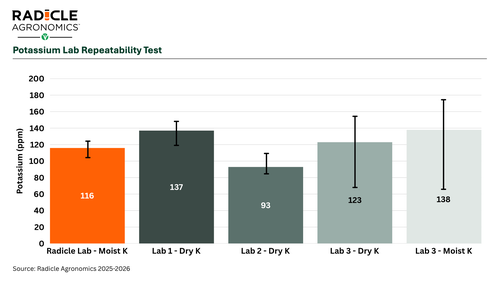
Potassium soil tests often exhibit greater variability than phosphorus, which increases the economic consequences of inconsistent results. In the same comparison study, potassium results from a moist potassium extraction provide a strong illustration.
The Radicle Lab reported an average potassium value of 116 ppm over four months, with reported values ranging from 104 ppm to 125 ppm. According to Iowa State University potassium recommendations, this range consistently falls within the optimum soil test category. Across the four months, the recommended potassium application rate remained 46 pounds of K2O per acre.
Another laboratory performing a moist potassium analysis (Lab 3 Moist K in the table) reported a much wider range of results. While the average potassium value was 138 ppm, reported results ranged from 65 ppm to 175 ppm over the four-month period.
A potassium value of 65 ppm places the soil in the low category, with a recommended application rate of 110 pound of K2O per acre. A value of 175 ppm places the soil in the high category, with a recommendation of zero pounds of K2O per acre. For the same soil, recommended potassium rates ranged from 0 to 110 lbs/A.
With potash priced around $500 per ton, this variability can change fertilizer costs by over $45/A. Over time, inconsistent potassium recommendations can influence nutrient balance and soil fertility trends.
Why Consistency Supports Better Agronomy
Consistent soil test results allow farmers and agronomists to track nutrient trends over time, evaluate management changes and compare fields with greater confidence. When soil test results are repeatable, changes in values are more likely to reflect true differences in soil fertility rather than testing variability. This supports more informed nutrient management and long-term soil health planning.
Soil testing is not about minimizing or maximizing fertilizer rates – and values provided by Radicle testing will not always result in lower recommended rates. The purpose is to provide dependable information that supports sound agronomic decisions. In an environment of high fertilizer prices and tight margins, reliable soil test data is not optional. It is foundational to profitable, data-driven agriculture.