The Value of a Soil Test
Article Summary
- A single, accurate soil test can guide fertilizer decisions for multiple years, helping growers move from default, full-rate programs to data-driven maintenance or reduction strategies without increasing agronomic risk.
- Most fields are already overfertilized, with partner data showing high or very high phosphorus and potassium levels often due to applying fertilizer out of habit rather than soil need.
- Soil testing consistently pays for itself, identifying where high fertilizer costs can be safely cut with minimal yield impact, especially in tight-margin, high-input-cost environments.
From Confusion to Clarity: The Value of a Soil Test
Soil testing provides an astonishing amount of valuable information. It tells us what nutrients are available, what is lacking, and where fertilizer dollars are most likely to pay. Yet despite its value, the expense and notion that the soil doesn't change rapidly may mean you only sample every two to four years. In some cases, input cost spikes or yield slips may be the only red flags a farmer would say warrant soil sampling at all.
That hesitation is understandable. Soil testing takes time, costs money and doesn’t immediately look like yield gain. But when paired with sound agronomic guidelines, that soil test can save you thousands of dollars on unneeded inputs.
One Soil Test Can Inform Years of Fertility Decisions
State land grant universities base phosphorus and potassium recommendations on long-term crop response data. Those recommendations are not designed to change year over year unless soil test levels change meaningfully. When soil nutrient levels are already in the ‘optimum’ or higher categories, fertilizer recommendations often shift to maintenance or even zero application.
This means the data from a single soil test can guide fertilizer decisions for two, three or even more years, making it critical that it’s accurate. Instead of guessing or defaulting to a full-rate program, growers can confidently adjust fertilizer rates knowing the soil nutrient supply is sufficient to meet crop demand.
In tight-margin environments, the long-term value of a soil test is clear. It’s not just a snapshot of today’s fertility. It’s a roadmap for future decisions.
Many Fields Are Already Overfertilized
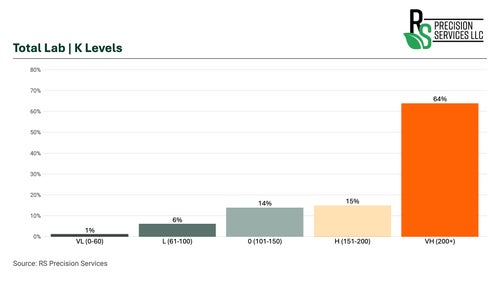
Data from our Radicle partner, RS Precision Services, makes this point clear. In this large dataset of fall soil samples grouped by Iowa State’s guidelines for fertility categories, the majority of fields tested were already above optimum levels.
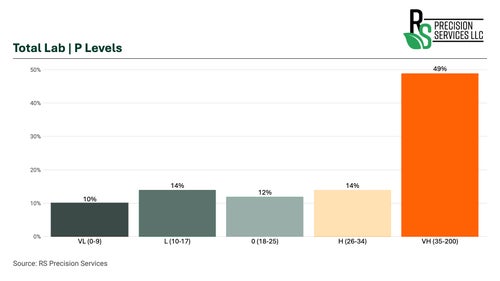
Approximately 65% of soil samples tested high or very high in phosphorus. Nearly 80% tested high or very high in potassium. These elevated fertility levels were not the result of specialized programs like manure-heavy systems. They were most often seen where farmers continued applying full-rate broadcast phosphorus and potassium year after year, regardless of what soil tests showed.
This pattern is common. Fertilizer programs often continue out of habit, risk aversion and concern that skipping an application could hurt yield. But when soils are already over-supplied, additional fertilizer rarely provides a return on investment.
What is the True Cost of Overfertilizing?
To understand the economics, consider a real example field from the RS Precision dataset. This field had average soil test values of 48 ppm phosphorus and 262 ppm potassium, well above published optimum ranges for corn and soybeans.
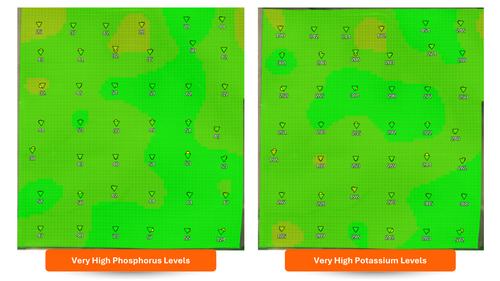
Historically, this 111-acre field received a blanket application of DAP and potash following harvest. At prices of $850/ton for DAP and $490/ton for potash, and a rate of 200 lb/A for each product, the cost of fertilizer alone was roughly $134/A. Across the entire field, that adds up to $14,874 before application costs.
The soil tests told a different story. With fertility levels already above optimum, research shows little to no yield response would be expected from additional P or K. In contrast, the cost of a grid or zone-based soil test is a fraction of that fertilizer bill, and the information from that test can be used for several seasons.
In this case, the soil test paid for itself many times over by identifying where fertilizer dollars could be cut with minimal agronomic risk.
What PTI Research Shows About Cutting Back
The Precision Planting PTI Farm has spent years studying fertilizer rate efficiency. In the ongoing Broadcast vs Banding Rate Efficiency Study, researchers evaluated a wide range of fertilizer rates, including a zero-pound-per-acre treatment, and tracked both yield and economics.
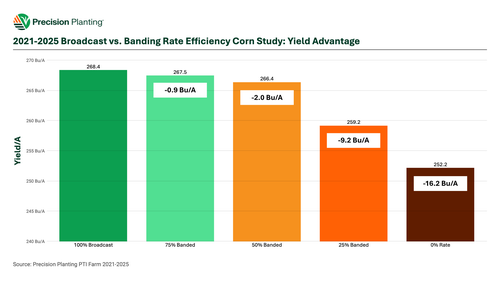
The results showed that applying zero fertilizer resulted in the largest yield losses, confirming that nutrients still matter. But the economics are more nuanced. When fertilizer prices are high, cutting rates by 50 to 75% often results in only small yield losses of 1-2 Bu/A. Those losses were frequently offset by significant savings in fertilizer cost.
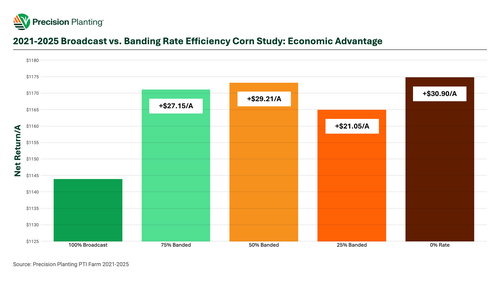
In some high-fertility situations, even aggressive rate reductions improved net return*. The takeaway is not that fertilizer can be eliminated permanently, but that soil testing allows growers to fine-tune rates instead of defaulting to the most expensive option every year.
Stop Guessing. Start Sampling.
In times of high fertilizer prices and tight margins, guessing is expensive. A soil test replaces uncertainty with clarity. It shows where fertility levels are already sufficient, where fertilizer can be reduced, and where investment is still justified.
Soil testing is not about applying less. It is about applying smarter and protecting your fertilizer dollars.
Radicle offers tools that help make the soil testing process easier and more actionable. GeoPress simplifies high-quality sampling. Radicle Lab provides consistent, agronomically sound results. The Radicle App ties it all together, helping growers turn soil data into confident decisions.
Stop guessing. Start sampling. The confidence and clarity are worth it.
*Please note: the field started with P levels at 33ppm and K levels at 182ppm, both considered above optimum.