Soil Sampling Done Right
The Hybrid Approach
Article Summary
- Soil sampling is a foundation of precision agriculture that drives smarter fertility and input decisions.
- Grid sampling offers efficiency, while zone sampling improves accuracy by capturing field variability.
- A hybrid approach combines both strategies to deliver practical, high-value soil data.
Every pass across your field is an investment. Soil sampling is no different. If you want better ROI on your fertilizer budget, stronger yields and smarter decisions, it starts with how you pull a core from the ground. Done right, soil sampling turns variability into opportunity. Done wrong, it can create noise that leads to added costs and misinformed decisions.
Soil sampling is how you learn what’s really happening below the surface. It gives you the data to make confident agronomic decisions around fertility, population, hybrid selection and more.
Fields are never uniform. Even the flattest field has variability in soil type, organic matter, drainage and nutrient availability. The goal is to capture that variability accurately so your decisions match reality.
Here’s how to get it right.
Core Principles of Effective Soil Sampling
There are three key goals for soil sampling, and it’s important to keep these in mind before choosing a sampling strategy.
- Represent the field
Every sample should reflect the environment it comes from. Avoid bias by skipping odd spots that may have skewed nutrient levels like field edges, headlands, old fencerows, livestock feeding areas, burn areas or anywhere that was used for storage. - Be consistent
Depth and location matter. Inconsistent sampling introduces error faster than anything else. Keep a standard depth and sample collection method across every acre. - Stay efficient
Sampling windows are tight. Whether in fall or spring, your process must be fast enough to cover acres without sacrificing quality. Use the right tools to keep you moving accurately and progressing effectively.
Soil Sampling Strategies
There is no one-size-fits-all approach. Each of the strategies outlined below can be effective and generate useful datapoints. The best strategy for you depends on your individual operation, technology and goals.
Grid Sampling
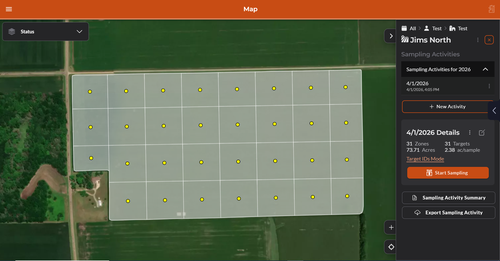
Grid sampling places points at consistent intervals across the entire field, typically in 2.5 to 5-acre grids. Simply generate a pattern of evenly spaced points at the center of each grid space and collect samples at each location. Grid sampling is effective when you need consistency and speed, especially across large acre operations.
Advantages
- Fast and simple – setup in minutes with tools like the Radicle App
- Covers entire field uniformly
- No sampling bias – locations are chosen purely based on distance from the other samples
Challenges
- Treats every acre the same
- Ignores soil type changes, topography and yield history
- May not consistently identify management zones
Zone Sampling
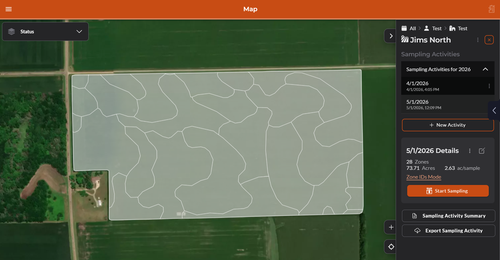
Zone sampling groups similar areas together based on agronomic data. Define your own management zones using layers like soil type map, yield maps, elevation data and satellite imagery. Then pull composite samples within the entire zone. Zone sampling works best for farmers focused on maximizing input efficiency with variable rate applications.
Advantages
- Reflects real-world soil variability
- Aligns sampling with production zones
- Supports targeted fertility strategies
Challenges
- Requires more upfront analysis
- Takes time to build accurate zones
- Dependent on quality of the data layers
The Hybrid Approach: Best of Both Worlds
We believe the most effective strategy combines grid and zone principles into a hybrid sampling strategy. Tools like the Radicle App simplify the process by overlaying soil data and letting you quickly adjust sampling points. In just a few minutes, you can build a sampling plan that is both practical and agronomically sound.
Start with a grid to establish consistent coverage. Then refine it using soil type maps and field data. Shift points out of transition areas and into representative zones. Add extra sampling locations where variability is high.
This approach gives you:
- The efficiency of grid sampling
- The accuracy of zone-based decisions
- Better representation of soil variability
Tips for Better Soil Sampling Results
- Sample at the same time each year for consistency
- Maintain a standard sampling depth, typically 6 to 8 inches for most crops
- Use clean probes to avoid contamination
- Label and track samples carefully
- Consistent sampling locations are good for monitoring trends, but changing some locations can uncover hidden variability
Turn Data into Action
Soil sampling is not the goal. Better decisions are. Once results come back, you can use them to:
- Align agronomic strategies with field variability
- Identify nutrient deficiencies
- Adjust application plans
- Build a variable rate fertilizer prescription
The real value comes from turning soil data into action across your acres.